Beacon is DataKind’s new, expanded local data platform, shaped by years of learning and co-development alongside practitioners and evolving DataKind’s earlier community data infrastructure efforts into a more collaborative, action-oriented experience.
Designed to support economic mobility and community impact, Beacon equips practitioners with the data, insights, and collaborative tools needed to strengthen small business support, community service delivery, proactive policy change, and more. Beacon enables users to turn disconnected public and private data into coordinated, insight-driven actions, while also building the organizational fluency and data foundations needed to harness – and shape – the next generation of AI tools.
Developed with the support of the Mastercard Center for Inclusive Growth, Beacon brings together multi-domain community indicators, organizational data, mapping, team-based workflows, and analysis tools in one accessible platform to help social impact organizations deliver equitable outcomes.
Users can identify service gaps, target outreach more effectively, and strengthen financial security and overall community health – and in doing so, surface data gaps and infrastructure needs that inclusive AI will depend on.
The interventions that support economic mobility are well understood. CDFI investment, small business support, affordable housing, workforce development, and financial inclusion programs all play critical roles in strengthening communities and expanding opportunity.
But organizations are often forced to make decisions using disconnected datasets, siloed workflows, and static reporting tools that make coordinated action difficult.
Beacon was built to help close that gap.
Beacon is also part of a longer journey. As AI continues to reshape how organizations analyze information, allocate resources, and make decisions, communities and organizations need the data foundations, skills, and confidence to engage with these technologies on their own terms.
Beacon is designed to be the data foundation that makes AI useful. Having clean, standardized, place-based community data enables organizations to use AI-powered workflows to accelerate analysis, generate deeper insights, and automate outreach at scale.
Beacon helps build that readiness – delivering practical value today while strengthening the capacity to responsibly adopt and shape the next generation of AI-enabled tools.
How Beacon works in practice: A program officer can combine internal program data with public indicators such as SBA loan activity, household economic stability metrics, and small business listings to identify underserved businesses and build a more targeted outreach strategy. By bringing these datasets together in one place, Beacon helps organizations move from geographic insight to coordinated action.
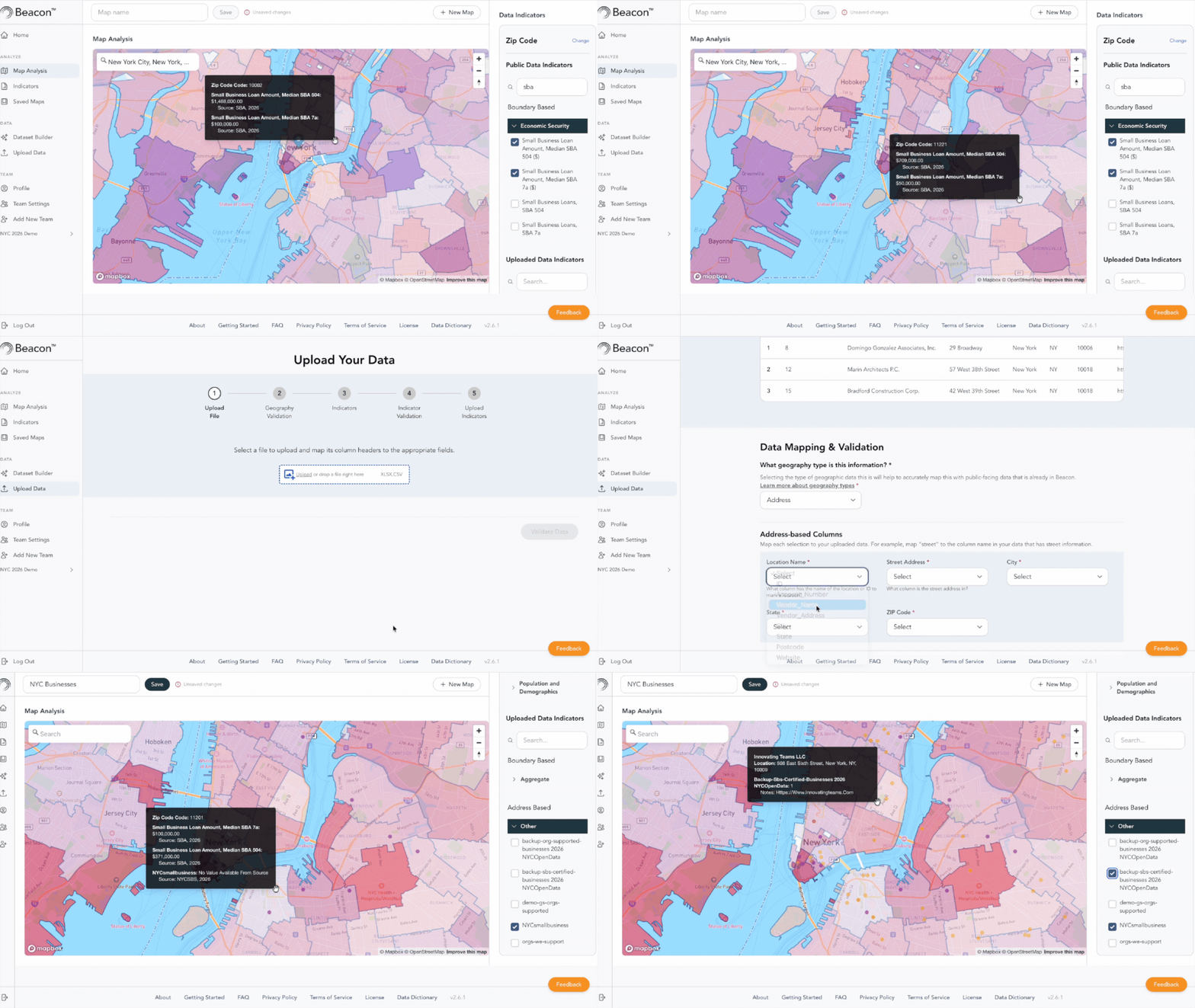
From map to action: Identifying underserved small businesses and prioritizing outreach in New York City using Beacon. Example includes NYC Small Business Services Certified Business Listings (via NYC Open Data).
Evolving What Practitioners Need Most
Beacon brings together years of product development and practitioner learning into a single platform.
Earlier financial inclusion data work developed alongside CDFIs, small business support organizations, and economic mobility practitioners demonstrated that standardized, downloadable economic data is foundational to understanding community need and opportunity.
Capabilities pioneered through our EO Datascape are now embedded within Beacon’s Dataset Builder, giving users direct access to curated public datasets that historically required significant technical expertise to assemble and prepare.
Beacon builds on that foundation by combining data access with mapping, organizational data integration, collaboration tools, and decision-support workflows in one place – helping organizations move from understanding community conditions to taking coordinated action.
Why Beacon is Different
Beacon is free to access and designed for practitioners working across economic mobility and community impact initiatives every day – including program managers, loan officers, outreach coordinators, nonprofit leaders, service providers, and policy teams.
The platform combines more than 55 public indicators across economic mobility, housing, demographics, transportation, health, food access, and financial well-being into one accessible experience, helping organizations understand local community conditions and make more informed decisions without requiring specialized data expertise.
Key capabilities include:
- Economic mobility-focused indicators: Access pre-loaded indicators related to financial health, capital access, small business growth, housing stability, transportation access, and broader community conditions.
- Place-based analysis: Explore trends across ZIP code, county, Census tract, and congressional district levels.
- Public + organizational data together: Securely integrate program records, CRM exports, outreach data, loan portfolios, surveys, and service data alongside public indicators in one analytical environment.
- Operational decision support: Compare organizational reach against local economic conditions to identify service gaps, prioritize outreach, and better target investments.
- Dataset Builder: When data preparation requires technical expertise most organizations don’t have, the communities that need investment most go unseen in the evidence. The Dataset Builder puts that capability within reach, giving CDFIs, small business support organizations, and economic mobility practitioners instant access to pre-standardized public datasets that typically are accessible to organizations with dedicated data teams. These clean, standardized datasets can also serve as a foundation for AI-assisted analysis and reporting workflows, helping organizations generate insights more efficiently while maintaining confidence in the underlying data.
- Team-based collaboration: Save analyses, revisit insights, share findings with stakeholders, build shared institutional knowledge over time, and support cross-functional decision-making across teams and organizations.
- Easy to use: Navigate mapping and analysis workflows without requiring advanced GIS or data science training.
Supporting Economic Mobility & Community Impact
Beacon helps organizations move beyond static reporting toward more dynamic, collaborative decision-making.
Small Business Support & Financial Inclusion
CDFIs, small business support organizations, and economic mobility practitioners can use Beacon to understand where investment flows relative to local economic indicators and identify communities that may be underserved or overlooked.
By layering outreach or investment data against indicators related to household economic stability, capital access, business density, and economic vulnerability, organizations can better target support and strengthen equitable access to economic opportunity.
Service Delivery & Community Benefits
Organizations delivering community services can compare program reach against indicators related to transportation access, food access, health outcomes, housing instability, and other local conditions.
This supports more targeted outreach strategies, stronger program planning, and evidence-based resource allocation.
Cross-Sector Coordination
Beacon’s collaboration features help organizations coordinate around shared evidence rather than disconnected spreadsheets or isolated reports.
Teams can align around common community questions, identify service gaps more collaboratively, and strengthen coordination across economic mobility initiatives.
What Comes Next
Over the coming year, DataKind will continue expanding Beacon’s data coverage, analytic capabilities, secure data integrations, and onboarding experience to reduce barriers for organizations using data in everyday decision-making.
As organizations increasingly adopt AI-powered tools, DataKind sees Beacon serving as a trusted data foundation for those workflows. Beacon’s Dataset Builder and integrated community indicators can help organizations prepare clean, standardized datasets for AI-assisted analysis, reporting, outreach planning, and decision support – ensuring that emerging tools are grounded in reliable community data rather than incomplete, outdated information.
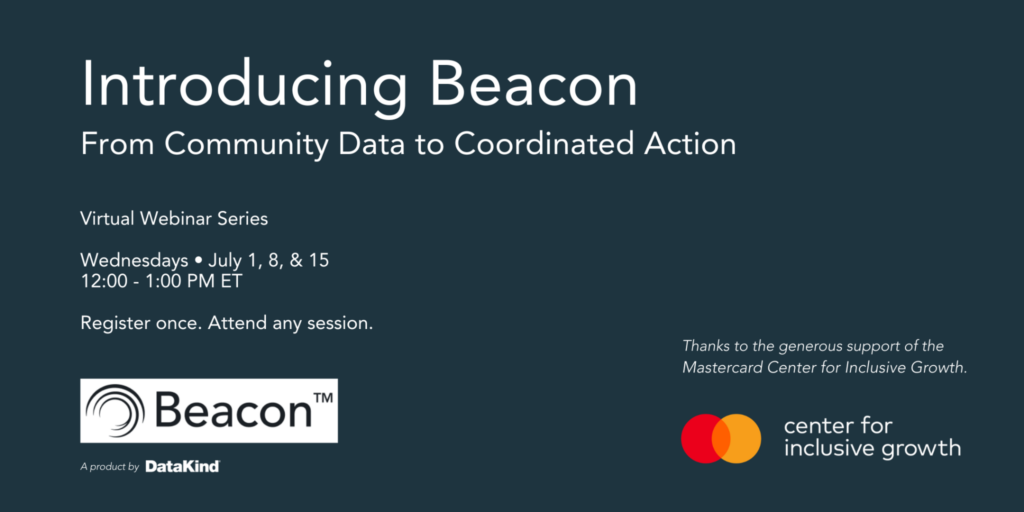
To continue the conversation, DataKind is launching a webinar series beginning Wednesday, July 1 at 12 PM ET. The series will bring together practitioners, partners, and data experts to explore real-world approaches to:
- Economic mobility and financial inclusion
- Service delivery and community need
- Cross-sector collaboration and data sharing
Through practical examples and practitioner perspectives, the series will demonstrate how organizations can use Beacon to better understand community conditions, coordinate action, and support more informed decision-making.
Explore & Engage
- Explore Beacon
Learn how organizations are using Beacon to turn community data into coordinated action.
explorebeacon.org - Join the Webinar Series
Real-world examples, practitioner insights, and applied strategies for community decision-making.
Register here.
Stay Connected
- Talk to the Beacon Team
For partnerships, questions, or collaboration:
beacon@datakind.org
This program is made possible thanks to the generous support of the Mastercard Center for Inclusive Growth.
Join the DataKind movement.
- Interested in sponsoring a project? Partner with us.
- Interested in subscribing to our newsletter? Sign up.
- Interested in supporting our work? Donate here.