Humanitarian and disaster response organizations are increasingly asking not whether AI matters, but how to make it useful in practice.
The opportunity is significant: AI can help teams synthesize fragmented information, draft reports more quickly, communicate across stakeholders, and identify patterns that might otherwise remain buried across documents, datasets, and field inputs. But realizing that value requires more than access to new tools. It requires practical training, trusted workflows, strong data practices, and a clear understanding of where human judgment remains essential.
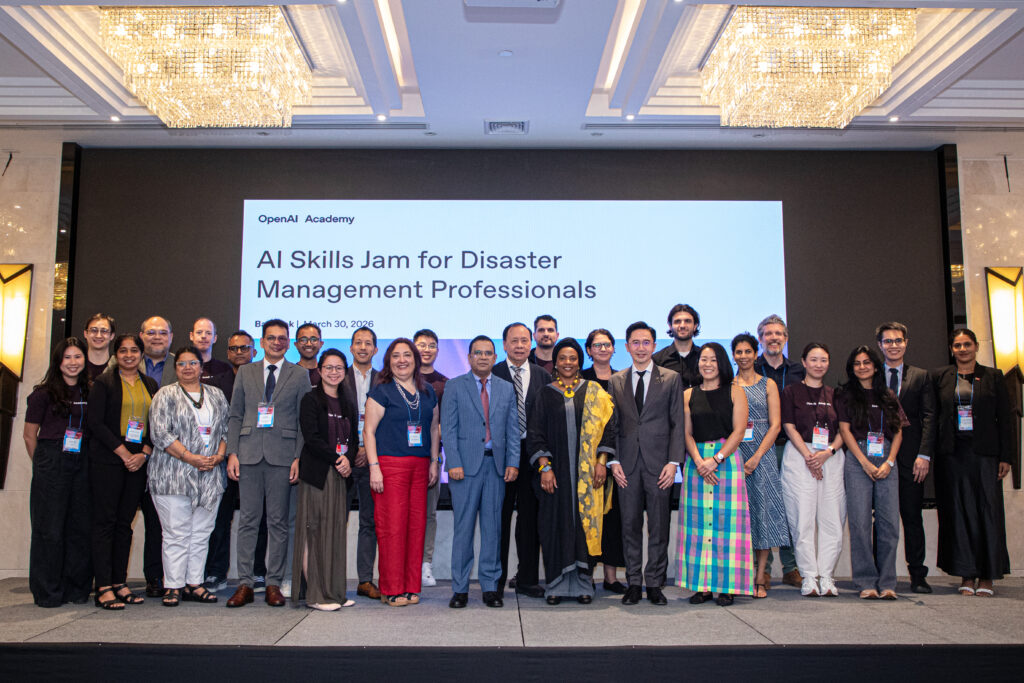
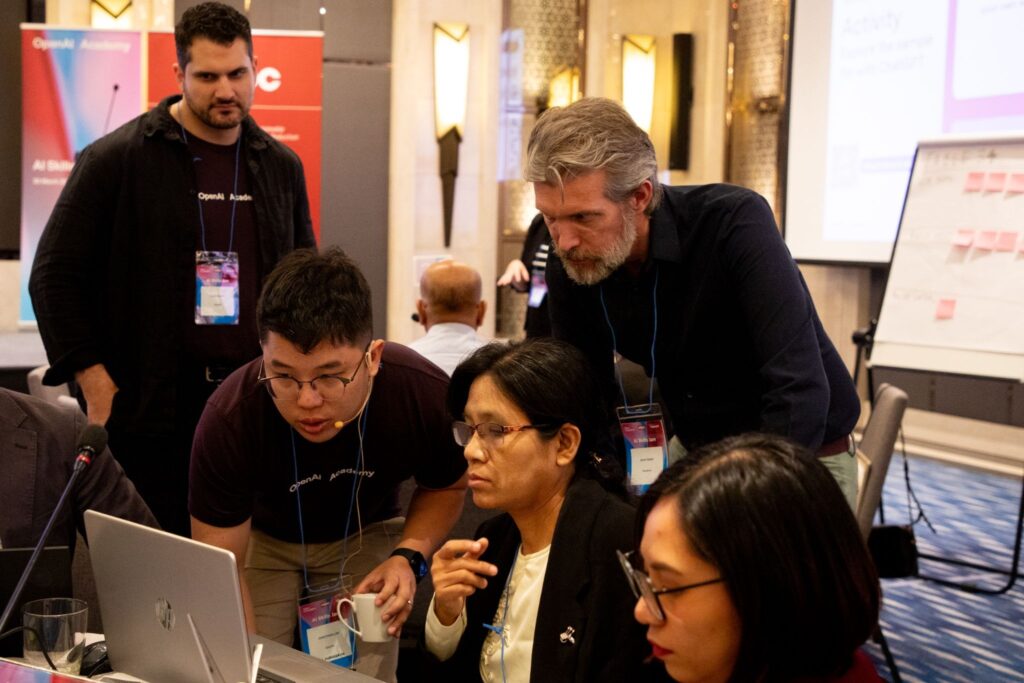
That was the focus of a recent AI Skills Jam in Bangkok with disaster management professionals from across Southeast Asia. The collaboration combined OpenAI Academy’s practical AI training approach with DataKind’s humanitarian data expertise and the regional convening strength of the Gates Foundation and the Asian Disaster Preparedness Center (ADPC).
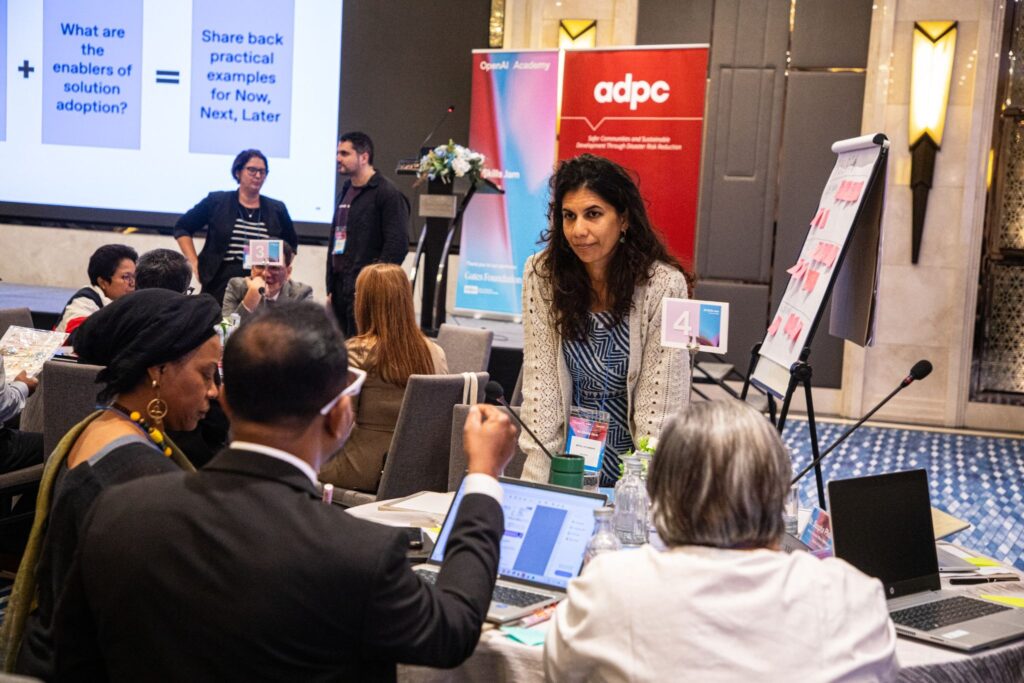
Through hands-on sessions and structured discovery, participants explored where AI can reduce operational burden today, where organizations need more support to scale responsibly, and which use cases are most ready for further design and testing.
What emerged was a clear view of both the promise of AI in this space and the practical work required to move from experimentation to implementation.
The gap isn’t belief – it’s readiness
A consistent pattern emerged: strong belief in AI’s relevance, but limited organizational readiness to adopt and scale it.
There is broad alignment that AI will play a meaningful role in the coming years. Participants consistently described it as highly relevant to their work and expressed optimism about its impact.
Yet adoption remains early and uneven. Across the organizations represented, AI use is still largely informal – driven by individual experimentation rather than embedded in core workflows or systems.
This reflects a broader trend across the sector: insights from the Humanitarian Leadership Academy show that while AI usage is widespread – with 93% of respondents reporting use and 70% using it weekly or daily – only 4% consider themselves expert users, highlighting a significant gap between adoption and readiness.
The limiting factors are less about interest and more about structure:
- Data governance and risk management processes are still evolving
- Clear guidance on responsible use is often limited
- Staff need training that connects directly to their day-to-day work
Closing this gap will be critical to moving from exploration to consistent, organization-wide impact.
The most immediate value is in everyday work
While higher-risk or more complex applications, such as predictive modeling and real-time decision support, continue to generate interest, the strongest signal from practitioners was more practical and immediate.
The greatest opportunity lies in improving the work that already underpins disaster response:
- Drafting situation reports (SITREPs)
- Preparing donor reports and proposals
- Synthesizing large volumes of information quickly
- Coordinating across teams, organizations, and time zones
These examples reflect the core administrative and coordination workload that defines day-to-day disaster response operations – much of it repetitive and time-consuming, and precisely where practitioners are looking to AI to improve speed and accuracy.
Reducing the time and effort required to complete this work can have an outsized impact, particularly in high-pressure environments. Across the Bangkok sessions, these use cases were consistently identified as high priority, reflecting both urgency and feasibility.
Data remains both a barrier and an opportunity
Challenges related to data surfaced consistently across pre-event surveys, in-room exercises, and post-event discussions.
Managing fragmented information emerged as the single biggest opportunity area. In pre-event survey responses, 63% of participants identified situation report drafting and summarization as one of their most time-consuming tasks. Open-ended responses also repeatedly pointed to reporting, proposal development, and disaster information management as areas where AI could meaningfully reduce effort and improve quality.
Across the sessions, these challenges showed up in multiple ways:
- Access to reliable, up-to-date information
- Difficulty combining datasets across different sources
- Questions of data quality, provenance, and trust
- Limited visibility into what data contains or how it can be used
Participants also highlighted broader structural issues – with data spread across Excel files, PDFs, Word documents, and field inputs, making consolidation slow and error-prone. At the same time, the burden of producing timely reports, proposals, and updates continues to grow, often limiting time for core program delivery.
These constraints shape what is possible with AI today. They also highlight one of its most immediate opportunities: helping teams structure, synthesize, and make sense of fragmented information – and turn it into actionable insights more quickly.
Strengthening data practices, workflows, and tools will be foundational to unlocking broader impact.
Speed, synthesis, and communication are critical
Across surveys, working sessions, and follow-up discussions, three needs consistently rose to the top:
- Speed – the ability to act quickly in time-sensitive situations
- Synthesis – turning large volumes of information into clear, actionable insight
- Communication – sharing accurate, timely information across stakeholders and contexts
These needs are closely interconnected. Delays in consolidating data slow insight generation, and slow insights impact the ability to communicate effectively in high-pressure environments.
AI has the potential to significantly improve how organizations navigate each of these areas – particularly by accelerating reporting workflows, reducing manual effort, and helping teams prepare clearer information for time-sensitive decisions.
Together, these insights point to a clear priority: near-term impact will come not from entirely new systems, but from strengthening the core workflows that already define disaster response.
What’s missing points to what’s next
The discovery process also surfaced a notable gap: some high-potential applications were not immediately top-of-mind for participants, even though they map closely to persistent humanitarian challenges. These include:
- Digitizing offline and handwritten data collection
- Multilingual communication and translation
- Community engagement and feedback mechanisms
- Interoperability across systems
- Solutions designed for low-bandwidth environments
This gap likely reflects limited exposure to rapidly changing AI capabilities and the difficulty of translating operational pain points into technical use cases. As organizations gain more hands-on experience, these areas may become increasingly important.
Practical training is a clear priority
One of the most consistent themes across participants was the need for applied, hands-on learning. As one participant put it, “We would like to host you in person to train us,” reflecting a broader demand for learning that is grounded in real-world application.
There is strong interest in:
- Exercises grounded in real disaster scenarios
- Practical workflows that can be used immediately
- Case studies relevant to humanitarian contexts
- Live demonstrations of tools in action
This focus on practical application is already translating into action. As another participant shared, “I have already trained 80-100 staff on what I learned at the AI Jam and I would like to hold more trainings.”
Abstract discussions are less valuable than experiences that directly support day-to-day execution. This reinforces a core OpenAI Academy lesson: in high-trust sectors, adoption depends on guided practice with workflows people can use the next day.
From insight to implementation
The AI Jam was designed as the first phase of a broader effort: to surface needs, build skills, and identify where AI can deliver meaningful support in humanitarian contexts.
The next phase focuses on applying those insights.
There is clear momentum to move from learning to implementation. Participants consistently expressed both the mandate and motivation to scale AI within their organizations and networks. As one participant noted, “I received a mandate from a government leader to use AI to improve my operating department’s work,” while another shared, “We are ready to start small with a pilot and scale.”
Efforts are now centered on translating what was learned into a small set of prioritized, high-impact use cases for further development. Rather than broad exploration, the focus is on workflows where AI can be meaningfully tested and iterated – particularly in reporting, coordination, and information management.
This phase will bring partners together to co-design and prototype solutions in close collaboration with end users, with an emphasis on rapid testing, feedback, and refinement.
In parallel, there is a focus on developing solutions that are not only effective for individual organizations, but reusable across the sector – supporting shared infrastructure, common workflows, and broader adoption over time.
This progression – from insight to co-designed, reusable solutions – is critical to moving beyond experimentation toward solutions that can be adopted and adapted across organizations.
This approach builds on prior work developing open, reusable tools and data science and AI solutions in partnership with humanitarian organizations – including efforts like DataKind’s Humanitarian Data Insights Project, the Data Observation Toolkit, and Climate x Health Pulse – where the focus has been on turning complex data challenges into practical, usable resources.
Continuing the work at ICT4D
This work continues through collaboration, testing, and iteration.
At ICT4D 2026 in Nairobi, DataKind and partners will build on the Bangkok AI Jam by adapting OpenAI Academy materials for a hands-on session focused on practical AI workflows for humanitarian and development practitioners.
Participants will engage in interactive exercises designed to refine priority workflows, explore how AI can be applied in operational contexts, and provide input to inform early-stage prototypes.
The session will extend the co-design process, helping ensure that emerging solutions are grounded in real-world workflows and adaptable across different organizational contexts. If you’ll be in Nairobi, we encourage you to register and join the session!
AI has the potential to meaningfully strengthen humanitarian response. Realizing that potential will depend on how well solutions align with the realities of the field – and how effectively insights are translated into action at scale.
Images above courtesy of OpenAI.
Join the DataKind movement.
- Interested in sponsoring a project? Partner with us.
- Interested in subscribing to our newsletter? Sign up.
- Interested in supporting our work? Donate here.