By Sathy Rajasekharan, Vice President, Transformational Programs and Support, Parkinson Canada and former Independent Expert Advisor, Climate and Health, DataKind | Mignonne Fowlis, Senior Manager, Product and Programs, DataKind
In Kajiado County, Kenya, pregnant and postpartum women face mounting health risks from climate-sensitive conditions, including malaria outbreaks, heat stress, and disruptions from flooding and droughts. Yet, health officials lack the integrated, local, and timely data needed to anticipate and respond to these risks before they translate into adverse health outcomes.
When climate data sits separate from health records, and community insights remain isolated from both, health workers and decision-makers are unable to identify patterns, anticipate risks, or allocate resources effectively. This leads to a significant missed opportunity to strengthen health system resilience through better data integration and knowledge sharing across sectors, resulting in preventable illness, reactive rather than proactive care, and communities facing increased strain from climate-related health impacts.
Informed by insights from DataKind’s climate-health research, examining the key challenges that limit climate and health data integration and promising innovations centering local expertise, we asked ourselves: What if climate and health data was better integrated to inform local-level response? What could that unlock for stakeholders?
A Platform to Bridge Climate and Health Data
DataKind’s Climate x Health Pulse (Pulse), co-developed with Spectrum Africa, Jacaranda Health, and the Kajiado County Ministry of Health, is a web-based platform designed to integrate climate forecasts, health system data, and community insights for actionable, localized intelligence. Pulse brings together three critical data sources:
- Maternal health data from Kenya’s Health Information System (KHIS)
- Climate forecasts from Copernicus ERA5
- Community insights from Jacaranda Health’s PROMPTS digital health platform
An interactive demo of the Climate x Health Pulse platform.
Piloted in Kajiado County, Pulse enables local governments, implementing partners, and health workers to visualize trends, identify correlations, and anticipate risks at the county and sub-county level, from heat exposure monitoring and malaria outbreak preparedness to resource planning and data-driven policy decisions.
Below, we share how we built the Pulse prototype and the vision for developing it into a widely adopted tool.
Why a prototype?
DataKind’s climate-health landscape report revealed sector-wide interest in a climate-health data platform. Health officials, frontline workers, and community program leaders all recognized the need for better integration of local-level climate-health data. When asked what a platform should look like, the team heard everything from climate forecasting tools to ward-level heat maps to agentic AI models.
This emphasized different expressions of the same underlying need: better information to predict and respond to climate-driven health risks in real time.
To address this, DataKind built Pulse as a working prototype, recognizing that even an early-stage prototype gives stakeholders a shared reference point and something concrete to respond to, turning open-ended ideas into actionable decisions.
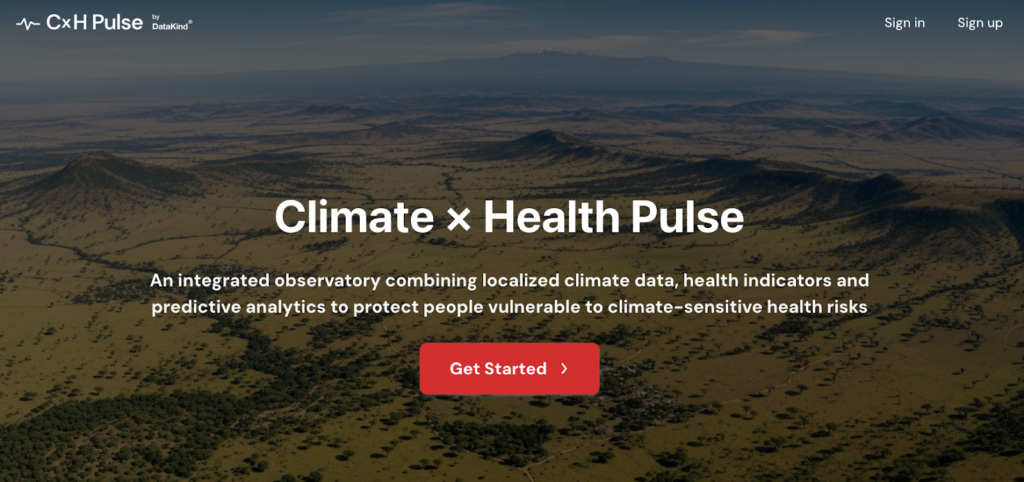
Climate x Health Pulse prototype landing page (pulse.datakind.org). Access is currently limited to project partners under a data sharing agreement.
How we built it
A key challenge emerged early: the difficulty of describing a data tool in words, especially when key collaborators speak different professional languages. Health experts focused on heat alerts and narrative reports, while engineers considered APIs and backend infrastructure, and designers prioritized visualizations.
Aligning on time-frame and geography
The breakthrough came when the team focused efforts on bringing all data into the same temporal and spatial dimensions. This involved:
- Temporal alignment: Standardizing all data to monthly intervals to match KHIS reporting, which processes health statistics monthly
- Spatial alignment: Balancing facility-level KHIS and conversational data against the sparsity of data and the functional utility of spatial climate data
After weighing data volume, sparseness, and actionability, the team settled on ward-level data – detailed enough to be useful and aggregated enough to be reliable. Additionally, action can be taken up at a ward level, since there are administrative officers, both at health and other levels, who have ownership and responsibilities for these geographies.
Technical decisions guided by key principles
- Cross-sector collaboration: The tool brings together three domains, climate science, health analytics, and community data, each with its own nuances. DataKind’s strengths in health analytics and conversational data were complemented by published climate research. Ongoing collaboration with climate scientists will continue to strengthen the platform’s indicator selections and methodological rigor.
- Starting with data quality: Historical precipitation and temperature data required substantial work, including correcting unit errors, redefining aggregation methods, and rechecking time offsets.
- Models that provide actionable insights: The team used Generalized Additive Models (GAMs) to identify climate-health correlations that inform early-warning systems.
Additional methodological decisions came together once the framework was established: choosing appropriate rates and denominators for disease cases, aligning temperature categories with meaningful health thresholds (25°C, 30°C, 35°C) rather than arbitrary ranges, and ensuring heatmaps represented only one issue at a time.
Prioritizing climate-health use cases
One critical lesson shaped the development approach: prioritize building around user stories to inform feature lists. The team developed detailed user narratives for the product requirements document, synthesizing what we wanted users to gain from the platform, and helping the technical team understand not just what to build, but why it mattered.
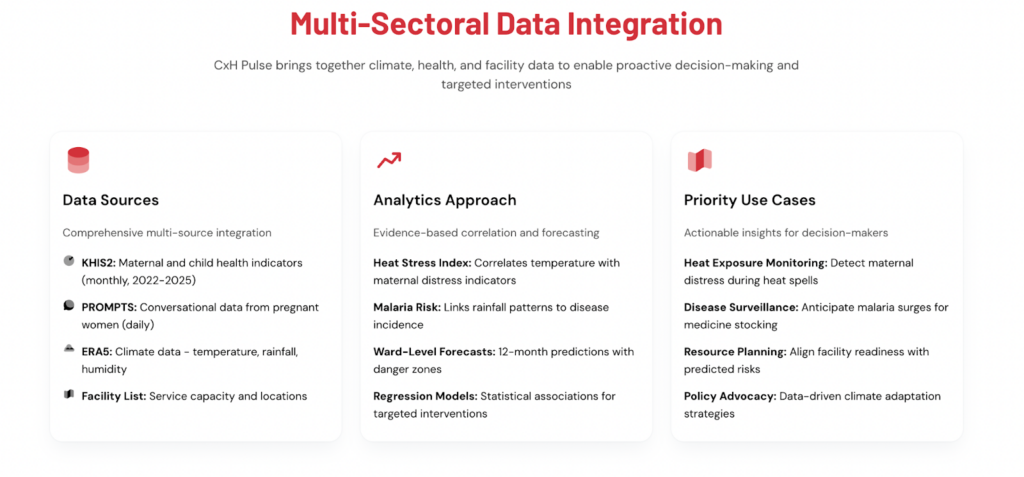
Overview of available data sources in Pulse, analytics approach, and priority use cases (pulse.datakind.org).
The role of forecasting models
The GAM-based prediction models in Pulse serve three practical purposes:
- Demonstrate feasibility: Show that meaningful correlations exist between climate variables and health outcomes
- Create early-warning logic: Establish seasonal baselines that can flag unusual patterns
- Validate the approach: Show that imperfect models can still support planning and decision-making
The modeling process generated important insights about how climate and health interact.
- Climate as one factor in a complex system: For maternal health outcomes, climate variables account for a portion of variance, while healthcare access, socioeconomic conditions, and other factors play equally important roles. Understanding this complexity helps users interpret forecasts appropriately.
- Context matters for interpretation: The team initially found strong correlations between temperature and neonatal mortality in certain geographies. Further analysis revealed that these patterns largely reflected the locations of referral hospitals rather than underlying risk, underscoring the importance of local context. Accounting for referral patterns ultimately strengthened the model’s accuracy and interpretability.
This also highlights the value of examining multiple indicators rather than relying on a single measure. For instance, metrics for severe acute malnutrition (SAM) were more geographically distributed and yielded insights that aligned more intuitively with climate patterns.
At the same time, it is important to account for delayed climate effects – such as malnutrition emerging months or even a year after drought-driven crop failures. Incorporating additional data sources, including contextual signals like news reports, can help capture these lagged and indirect impacts more effectively.
The path forward – building together
The key to building on the Pulse prototype is engaging with stakeholders – from national and county health officials, to frontline health organizations and health facility leaders. In further developing Pulse, DataKind is focused on understanding how the platform’s design works for these users, whether it reflects local climate and health dynamics and realities, and how stakeholders can integrate the tool into their planning and response activities.
The power of partnerships
Pulse demonstrates what’s possible when moving from research to action. By creating a working prototype, DataKind has established a shared proof point that climate data, health system information, and community insights can be integrated to support local decision-making and early warning systems.
The next phase depends on two critical partnerships:
- Learning from users: DataKind is engaging national and county health officials, frontline health organizations, and facility leaders to understand how the platform works in practice – whether it reflects local climate and health realities and how it can integrate into existing planning and response workflows.
- Expanding expertise: Building the prototype surfaced questions that require cross-sectoral collaboration. What are the optimal heat-health thresholds for pregnant women in East African contexts? Which climate models best capture regional micro-climates? Should the platform incorporate humidity, soil moisture, or vegetation indices?
These questions require climate scientists who understand regional weather patterns, maternal health specialists who know how heat affects pregnant women in practice, epidemiologists with expertise on disease surveillance nuances, and frontline health workers who hold knowledge about what works in their communities.
At DataKind, success means developing products that are widely adopted and contribute meaningfully to addressing sector-level challenges.
DataKind is actively seeking partnerships with organizations and experts who can contribute specialized insight, challenge assumptions, and co-create solutions.
This collaborative approach transforms Pulse from a single prototype into a sustainable and inclusive community of practice – one that equips local governments, implementing partners, and health workers with the insights they need to anticipate and respond to climate-driven health risks before they translate into adverse outcomes.
You can view the Climate x Health Pulse here.
Attending ICT4D 2026 from May 20-22, 2026 in Nairobi, Kenya? We’re participating in a breakout session on how we built Climate x Health Pulse. Come meet us to learn more about how we developed Pulse.
Interested in contributing your expertise or piloting Climate x Health Pulse in your region, contact us at partners@datakind.org.
This work builds on insights from DataKind’s landscape report on climate-health data integration. Read the full report here.
Header image above courtesy of iStock/hanakaz.
Join the DataKind movement.
- Interested in sponsoring a project? Partner with us.
- Interested in subscribing to our newsletter? Sign up.
- Interested in supporting our work? Donate here.
Quick Links